
GA4 classifies 70.6% of your AI traffic as Direct by default (Verity Score, April 2026). Here is the complete method to make it visible in 15 minutes.
Is ChatGPT actually recommending your brand?
Measure your presence and identify the brands cited in your place. No credit card.
TL;DR:
- GA4’s native AI Assistant channel automatically recognizes ChatGPT, Gemini, and Claude since May 2026, but ignores Perplexity, Copilot, Mistral, and DeepSeek.
- 70.6% of traffic from AI mobile apps and ChatGPT Atlas lands in Direct due to missing referrer headers.
- A custom channel group with a personalized regex captures retroactively the traffic from platforms ignored by the native channel.
- LLM traffic converts 4.4 times better than organic search (Semrush, July 2025), making tracking financially worthwhile even at low volumes.
Why 70% of your AI traffic is invisible in GA4 by default
GA4 only sees visits whose browser transmits a valid referrer header. ChatGPT, Claude, and Perplexity mobile apps open links in a webview that does not transmit this header. As a result, the session lands in Direct, as if the user typed the URL directly.
The Verity Score study from April 2026 measures this phenomenon at 70.6% of AI sessions classified as Direct. An independent test by Retailgentic on the Gemini iOS app found only 5 visits identified as AI referrals out of 56, less than 9%. ChatGPT Atlas, the browser released by OpenAI in October 2025, also strips the referrer client-side.
Add to this the copy-paste problem. When a user copies a URL from a ChatGPT response and pastes it into a new tab, there is no referrer at all. The visit is permanently lost for source tracking.
For European sites, an additional layer further degrades measurement. GDPR requires a CMP that blocks analytics cookies until consent is given. Depending on implementation, 20 to 50% of sessions remain partially or totally unmeasured in Basic mode. Combined with missing AI referrers, your LLM traffic is doubly invisible.
The native AI Assistant channel: what GA4 measures since May 2026
Google added an AI Assistant channel to GA4’s Default Channel Group on May 13, 2026. The update is automatic. No configuration is required.
When GA4 detects a referrer matching a recognized AI assistant, it assigns three values simultaneously:
- Medium:
ai-assistant - Channel Group: AI Assistant
- Campaign:
(ai-assistant)
To find it in your interface, go to Reports → Acquisition → Traffic acquisition, then change the primary dimension to Session default channel group. If you have received AI traffic since May 13, 2026, an AI Assistant row appears.
The immediate benefit: you separate chatbot traffic from classic Referral traffic in one click. The Referral bucket previously mixed ChatGPT, a media site, and a commercial partner together.
What the native AI Assistant channel does not measure
The native channel has four limitations Google does not highlight. You need to know them before building reporting on this data alone.
Limitation 1: only 3 platforms recognized. Google confirmed the official list: ChatGPT, Gemini, Claude. Perplexity, Microsoft Copilot, Mistral, DeepSeek, Meta AI, Grok, and Poe remain in the generic Referral bucket. For B2B projects sensitive to sovereignty, ignoring Mistral penalizes measurement.
Limitation 2: measurement is not retroactive. Sessions prior to May 13, 2026 remain classified under Referral or Direct. If you compare year-over-year, you compare two different taxonomies. Add a visual annotation in GA4 at May 13 to avoid forgetting.
Limitation 3: mobile traffic remains invisible. The native channel relies on the referrer header. When the ChatGPT iOS app opens a link in an internal webview, the header is not transmitted. The session still lands in Direct, native channel or not.
Limitation 4: no signal for citations without clicks. GA4 measures clicks. If ChatGPT cites your brand in a response without any user clicking the link, GA4 does not see it. According to Seer Interactive (March 2026), only 12 to 18% of Perplexity citations generate a click. You miss 82 to 88% of your actual AI visibility.
How to configure a GA4 custom channel group for AI traffic
The custom channel group captures retroactively all sessions matching a regex, including platforms ignored by the native channel. It also applies to historical data.
The 6-step method:
- In GA4, click on Admin at the bottom left
- Under the Data display section, select Channel groups
- Click Create new channel group and name it Custom AI Traffic
- Click Add new channel and name it AI Chatbots
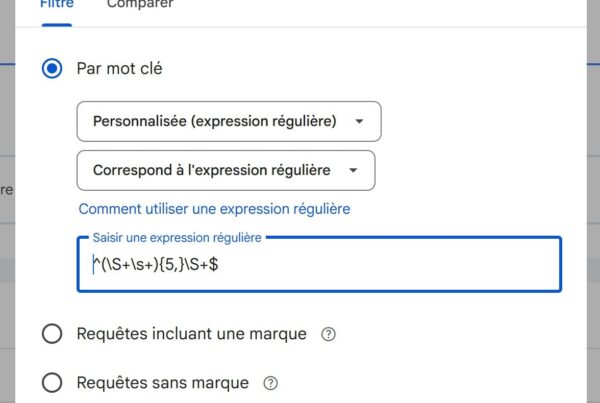
- Add a Session source condition with the matches regex operator and paste the regex from the next section
- Place the channel above Referral in the rule order, then save
Rule order matters. GA4 applies the first rule that matches. If you leave Referral above, your custom channel group will capture nothing. The configuration is retroactive: GA4 reapplies the rules to historical data preserved in your property.
Which regex to use to track AI in GA4 in 2026
The regex must cover current AI chatbots and anticipate new entrants. Here is the updated version for June 2026, including Mistral for the French-speaking market:
chatgpt\.com|chat\.openai\.com|perplexity\.ai|claude\.ai|anthropic\.com|gemini\.google\.com|copilot\.microsoft\.com|deepseek\.com|mistral\.ai|chat\.mistral\.ai|le-chat\.mistral\.ai|grok\.com|x\.ai|meta\.ai|you\.com|poe\.com|huggingface\.coA few clarifications on the selected patterns:
- chatgpt.com and chat.openai.com: OpenAI migrated its main domain in 2024, but the old one remains active for historical links.
- claude.ai and anthropic.com: both Anthropic domains may appear depending on sharing context.
- mistral.ai, chat.mistral.ai, le-chat.mistral.ai: the three Mistral patterns observed in France to date.
- huggingface.co: chatbots hosted on Hugging Face Spaces are becoming a rising source.
Update this regex every quarter. Domains change, new entrants appear. A stale regex misses your most recent traffic.
AI mobile traffic: how to recover what lands in Direct
AI mobile traffic remains GA4’s weakest link. No method captures it 100%, but three approaches help estimate it.
Approach 1: analyze Direct traffic spikes on most-cited pages. Identify the pages ChatGPT and Perplexity cite most for your brand using an AI monitoring tool. Compare the Direct traffic evolution on these pages versus the rest of the site. A structural gap signals hidden AI mobile traffic.
Approach 2: add UTMs on links from “citable” pages. For pages designed to be cited (FAQs, glossaries, comparisons), add a utm_source=ai&utm_medium=chatbot parameter on internal links leaving these pages. You then trace the internal post-AI-click journey, even if the entry remains in Direct.
Approach 3: server-side tracking via logs. The most reliable but most technical solution. Your server logs preserve the user-agent and source IP of each request. You can identify visits from AI bots (GPTBot, ClaudeBot, PerplexityBot) which are themselves signals of your exposure. This approach exceeds GA4’s native capabilities and requires a third-party tool or development.
Which KPIs to track in GA4 to measure AI traffic value
Once your tracking is in place, six metrics structure defensible reporting.
| KPI | What it measures | Why track it |
|---|---|---|
| AI sessions | Number of visits from the AI Assistant channel + custom group | Raw volume. Trend indicator. |
| AI engagement rate | % of engaged sessions (10s+, 2 pages, or conversion) | Quality signal. AI traffic often exceeds 60%. |
| AI landing pages | URLs receiving the most AI traffic | Identifies most-cited content. Guides your GEO strategy. |
| AI conversions | Assisted and direct conversions from the AI channel | The business metric. Justifies GEO budget. |
| Comparative conversion rate | AI CR vs Organic Search CR | Semrush measures 4.4x higher. Verify on your site. |
| Direct traffic on citable pages | Direct volume on pages known to be AI-cited | Proxy for masked AI mobile traffic. |
To go further, create a dedicated Looker Studio report that cross-references these 6 KPIs with your list of AI citations monitored by a third-party tool. Cockpyt provides this citation data as a complement.
What GA4 will never show you (and why it’s a blind spot)
GA4 measures clicks. It does not measure visibility. The distinction is massive in 2026.
When ChatGPT recommends your brand in a response without the user clicking, GA4 sees nothing. When Perplexity cites your article as a source in a list of 8 references, GA4 sees at best one click in ten. When Claude mentions you without including a link (a frequent case), GA4 is blind.
Yet, the Seer Interactive study (March 2026) on 541,213 LLM responses shows that 61.7% of AI citations are “ghost citations”: your content is used without your brand being named in the response. SparkToro × Gumshoe.ai measured that the chances of getting the same AI response twice are below 1 in 100.
Three questions GA4 will never answer:
- How many times is my brand cited by ChatGPT this week?
- What is my AI Share of Voice against my 3 direct competitors?
- On which queries does Perplexity recommend a competitor instead of me?
These questions require an AI monitoring tool that queries LLMs in parallel, archives their responses, and measures mentions, citations, and recommendations over time. GA4 remains useful for the visible tip of the iceberg, clicked traffic. The submerged part requires another layer.
Read also: Where does ChatGPT get its information?
FAQ: AI traffic in GA4
Why does my ChatGPT traffic appear as Direct in GA4?
Three main causes: the ChatGPT mobile app does not send a referrer header in its internal webview, the user copy-pasted the URL from the response rather than clicking, or ChatGPT Atlas (OpenAI’s browser) strips the referrer client-side. Partial solution: add UTMs on your citable links and analyze Direct traffic spikes on monitored pages.
Is GA4’s AI Assistant channel retroactive?
No. Measurement starts on May 13, 2026 and only applies to new sessions. Your historical data remains classified under Referral or Direct. For retroactive analysis, use a custom channel group: its rules apply retrospectively to data preserved in your property.
Should I keep a custom channel group if GA4 already has a native AI Assistant channel?
Yes. The native channel only covers ChatGPT, Gemini, and Claude. Perplexity, Copilot, Mistral, DeepSeek, and new entrants remain in Referral. The custom channel group complements the native channel and captures everything. Both work together without conflict.
How to track Perplexity in GA4 in 2026?
Perplexity is not included in the native AI Assistant channel. You must track it via a custom channel group with the regex perplexity.ai. Perplexity is one of the engines that transmits desktop referrers most correctly, but its mobile apps may land in Direct like others.
Does AI traffic convert better than classic SEO?
According to Semrush (July 2025), LLM traffic converts on average 4.4 times better than Organic Search traffic. The figure depends heavily on vertical and query type. Verify on your site by comparing the AI Assistant channel conversion rate to Organic Search conversion rate in GA4 over the same period.
Is Mistral tracked automatically in GA4?
No. Mistral is not on Google’s official list for the native AI Assistant channel. Add the patterns mistral.ai, chat.mistral.ai, and le-chat.mistral.ai to your custom channel group. Mistral remains minority in volume but its B2B growth in France justifies its inclusion.
Does Search Console show AI chatbot traffic?
No. Search Console only measures impressions and clicks from Google Search. It does not see ChatGPT, Perplexity, Claude, or Mistral. For these platforms, cross-reference GA4 (click side) with an AI monitoring tool (citation and mention side).
Sources
- Google Analytics Help Center, What’s New, May 13, 2026: AI Assistant channel announcement — support.google.com
- Search Engine Journal, Google Analytics Adds AI Assistant As Default Channel Group, May 2026 — searchenginejournal.com
- Verity Score, Why GA4 Lies About Your AI Traffic, April 2026 — verityscore.io
- Seer Interactive, LLM Ghost Citations, March 2026 — seerinteractive.com
- SparkToro × Gumshoe.ai, AI Brand Recommendation Inconsistency Study, January 2026 — sparktoro.com
- Authority Tech, How to Track AI Search Traffic in GA4, June 2026 — authoritytech.io