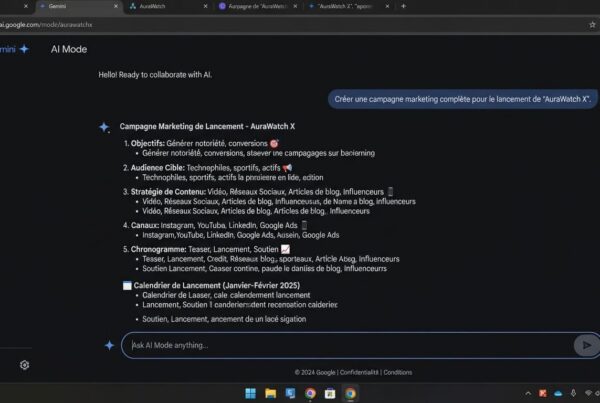

An AI Overview is a panel that appears on its own above Google’s results. AI Mode is a conversational tab the user deliberately opens. Both run on Gemini, and both went live in France on 22 July 2026.
That isn’t the real difference. The real difference is in the sources: Ahrefs compared 540,000 query pairs and measured just 13.7% overlap between the URLs each surface cites. Put plainly, 87% of the time they answer the same question while citing different pages.
I’m Florian Zorgnotti, an SEO and GEO consultant. What follows explains why being cited in one guarantees nothing in the other, and what that changes in how you measure and produce content.
Does ChatGPT recommend your brand?
Measure your presence and find out which brands get cited instead of you. No credit card.
Key takeaways
AI Overviews display passively above the results while AI Mode is a conversational tab the user chooses, but the decisive gap is that the two surfaces cite the same URLs only 13.7% of the time, which makes them two channels to track separately.
AI Mode vs AI Overviews: the difference in one sentence
An AI Overview is an answer Google gives you, AI Mode is a conversation you start. The first appears without any action on your part, above the blue links, on queries Google judges precise or complex enough. The second is a dedicated tab opening a chat interface where the user chains follow-up questions.
Both run on Gemini. Both use query fan-out, the mechanism that breaks your query into sub-questions before hunting for sources to answer each one. Google confirms this in its publisher documentation.
That shared plumbing is why everyone conflates them. It’s also why almost nobody measures the right things.
The full comparison table
| Criterion | AI Overview | AI Mode |
|---|---|---|
| Trigger | Automatic, no user action | Deliberate, via a dedicated tab |
| Placement | Above the blue links, inside the SERP | Separate interface, no organic results |
| Format | Short answer, a few lines | Roughly 4 times longer |
| Conversation | None, fixed answer | Chained follow-up questions |
| Sources cited | 7.7 domains per response on average | 9.2 domains per response on average |
| Responses with no source | 11% | 3% |
| Entities mentioned | 1.3 on average | 3.3 on average |
| Responses naming no brand | 59.41% | 34.66% |
| Favoured domain | YouTube, ahead of encyclopedic sources | Wikipedia, medical sources, Quora |
| Intent served | Quick answer, single fact | Deep research, comparison |
These figures come from Ahrefs’ December 2025 study of September 2025 US data, covering 540,000 query pairs for citation analysis and 730,000 for content similarity.
Why do the two surfaces cite different sources?
Because they run two independent searches. They don’t share a common source pool where one simply digs deeper than the other. Each fires its own query fan-out, with distinct models and techniques, and lands on its own selection.
The result is counter-intuitive. On identical queries, Ahrefs measures:
- 13.7% overlap in cited URLs, rising to 16.3% when looking only at each response’s top three citations.
- 16% word-level overlap. The two responses open with the same first sentence in 2.51% of cases.
- 86% semantic similarity. Nearly 9 response pairs in 10 score above 0.8.
Put another way: the two systems agree on what to say and disagree on where they found it. Ahrefs compares this to two experts answering the same question while citing different studies.
In my view, this is the point the French market will take longest to absorb, because it breaks a comfortable reflex. We all want to believe AI Mode is “AI Overviews, but longer”. The data says otherwise: these are two distinct selection engines converging on substance by separate paths.
The methodological caveat worth knowing
Ahrefs flags a limit openly. The analysis compares single generations of each response. Yet earlier research from the same publisher shows that 45% of an AI Overview’s citations change from one generation to the next. The source pools therefore likely overlap more than this snapshot suggests.
That limit doesn’t break the finding, it sharpens it. Even when several sources could support the same answer, the two surfaces pick different ones in practice. That’s what matters for you.
Which surface names brands more often?
AI Mode, by a wide margin. 59.41% of AI Overview responses name no brand or person at all, against 34.66% in AI Mode. The entity count shows the same gap: 3.3 on average for AI Mode versus 1.3 for AI Overviews.
The example Ahrefs gives on the query “cloud storage alternatives” is telling. The AI Overview names seven brands, once each, at the end of the response. The AI Mode response names twenty-three, spread throughout the text, starting from the very first sentence.
For a brand, the conclusion is clean. AI Overviews are a traffic surface: you win clicks through the source link. AI Mode is a reputation surface: you win named, repeated mentions in a comparison context.
The 61% rule
If your brand is mentioned in an AI Overview, there’s a 61% chance it also appears in the matching AI Mode response. AI Mode generally carries over every entity from the short version, then adds more.
Don’t read that as unqualified good news. You’ll be present, but surrounded by competitors who didn’t clear the short version’s filter. Your relative share of voice mechanically drops as the surface lengthens.
Should you optimise differently for AI Mode and AI Overviews?
Yes on format, no on substance. The foundation stays the same: real semantic authority on your topic, self-contained extractable passages, brand mentions off your own site. That’s what the 86% semantic similarity confirms: both surfaces hunt the same themes.
The divergence lies in what each surface prefers to consume.
What feeds AI Overviews
- Video: YouTube holds the top spot among cited domains, ahead of encyclopedic sources.
- Community platforms, Reddit foremost.
- Core pages: homepages and main category pages, cited nearly twice as often as in AI Mode.
- Short, direct formats, matching the generated answer’s own length.
What feeds AI Mode
- Encyclopedic sources: Wikipedia appears in 28.9% of AI Mode citations against 18.1% in AI Overviews.
- Long, well-sourced content, consistent with a 97% citation rate.
- Multi-entity comparisons, since the response names three times more brands.
- Quora, appearing 3.5 times more than in AI Overviews, and medical sources, cited almost twice as often.
My practical advice: don’t produce two pieces of content. Produce one that contains both formats. A short, self-contained opening passage for AI Overviews, then a dense, entity-rich comparative development for AI Mode. The same page can serve both surfaces if its structure allows it.
How do you track your presence in each surface separately?
By treating each surface as a distinct channel with its own measurement. A dashboard aggregating “Google AI visibility” without splitting the two will hand you a false number, since the two source populations barely overlap.
The minimum protocol fits in three columns. For each of your twenty strategic queries, record your presence in AI Overviews, your presence in AI Mode, and the brands cited in your place in each case. The gaps between the two columns are your opportunities: a query where you surface in AI Overviews but not AI Mode signals a shortfall in dense comparative content.
Two cautions are worth repeating. First, an isolated check is worthless, since nearly half of citations change between generations. Only share of voice aggregated across many checks produces a usable signal. Second, always separate citation, mention and recommendation: being cited as a source without being named builds no reputation at all.
That’s the logic I built Cockpyt AI on with Laurent Séjourné: weekly measurement across ChatGPT, Gemini and Perplexity, share of voice against competitors, a Google Analytics 4 connection linking visibility to real traffic, and a monthly GEO audit producing a prioritised action plan. Flat price at 29 euros a month billed annually, 14-day trial with no credit card.
The most common reasoning mistakes
- Believing AI Mode is AI Overviews in long form. The 16% word overlap says otherwise: these are two independent pieces of writing.
- Aggregating both into one metric. With 13.7% shared sources, the average hides two opposing realities.
- Optimising only for the short format. You forfeit the surface that names three times more brands.
- Concluding from a single check. Nearly half of citations change between two generations of the same response.
- Ignoring brand absence. In almost six AI Overviews out of ten, no brand is named at all: the battle then plays out on the source link, not the mention.
FAQ
Do AI Mode and AI Overviews use the same model?
Both rely on Gemini and on the query fan-out mechanism, confirmed in Google’s documentation. But they use different models and retrieval techniques, which explains why they select distinct sources while reaching similar conclusions 86% of the time.
Does being cited in an AI Overview guarantee appearing in AI Mode?
No, but the odds are favourable. When a brand is mentioned in an AI Overview, it reappears in the matching AI Mode response around 61% of the time. AI Mode often carries over every entity from the short version before adding others, which also increases the number of competitors around you.
Which surface drives more traffic to my site?
AI Overviews, because they display across a far larger query volume and without user action. AI Mode remains a tab the user must deliberately open. That said, AI Mode cites its sources far more consistently, with only 3% of responses lacking any source against 11% for AI Overviews.
Why do AI Overviews cite YouTube so heavily?
YouTube holds the top spot among domains cited in AI Overviews, ahead of encyclopedic sources. Two factors combine: Google leans on its own assets, and video transcripts provide dense textual material that models draw on readily. AI Mode, by contrast, tilts clearly toward Wikipedia and medical sources.
Do you need two separate pieces of content for each surface?
Not necessarily. A single page can serve both if it combines a short, self-contained opening passage suited to the AI Overview format with a comparative development rich in named entities suited to AI Mode. The shared foundation remains semantic authority on the topic, which both surfaces seek identically.
Does this US data apply to France?
Ahrefs’ measurements cover US data from September 2025. No equivalent study exists yet for the French market, since both surfaces have only been live there since 22 July 2026. The technical mechanisms are identical, but domain preferences could differ on a French-language corpus.
Does AI Mode replace the blue links?
Within its own tab, yes: the conversational interface shows no classic organic results. But it doesn’t replace the standard SERP, which still exists with its blue links and, on some queries, an AI Overview panel above them. The two experiences coexist and are tracked separately.
Sources
- Despina Gavoyannis and Xibeijia Guan, “Are AI Mode and AI Overviews Just Different Versions of the Same Answer? (730K Responses Studied)”, Ahrefs, 15 December 2025 — ahrefs.com
- Johan Sellitto, “Google lance officiellement les AI Overviews en France !”, Abondance, 22 July 2026 — abondance.com
- Google Search Central, “AI features in Google Search” documentation, accessed 22 July 2026 — developers.google.com
- SE Ranking, “AI statistics” (AI Mode / AI Overviews overlap measured at 10.7% of URLs), 2025 — seranking.com