
Traffic from AI engines converts 4.4 times better than organic (Semrush, 2025). The question is no longer which AI to use for your prompts. It’s which one cites your brand under the right conditions.
Key takeaways : ChatGPT, Claude, Perplexity and Gemini each have a distinct citation behavior. The best AI for your brand depends on your business objective, not your user use case.
Why the best AI is measured differently when you’re a brand
The question “which is the best AI” changes radically depending on who’s asking. For a regular user, the best AI is the one that answers prompts best. For a brand, it’s the one that cites them under the right conditions, at the right time, in front of the right audiences.
Recent figures validate this shift in question. According to the Stanford AI Index 2025, 78% of global enterprises have integrated AI into at least one function. On the traffic side, Semrush measured a 527% growth in referral traffic from AI platforms in 2025, with a conversion quality 4.4 times higher than classic organic traffic.
This traffic doesn’t split evenly between LLMs. Each AI has a distinct citation behavior, data partnerships, web access mode, user audience and hallucination profile. Brands that treat them all the same miss the essential.
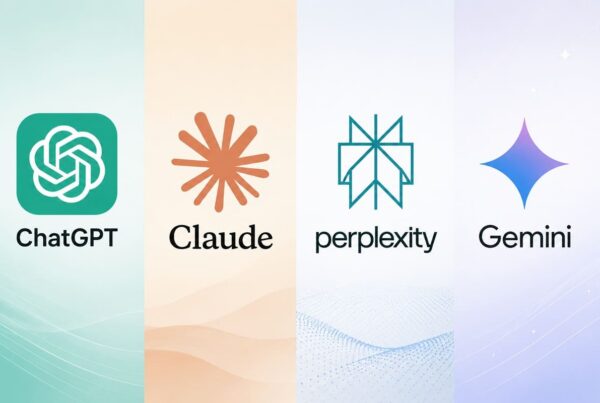
The best AI for your brand thus depends on three factors: your target (B2C, B2B, technical, local), your current GEO maturity, and your objective (raw visibility or measurable traffic). Here’s how ChatGPT, Claude, Perplexity and Gemini compare on these dimensions, in May 2026.
ChatGPT: the polyvalent pioneer that cites less explicitly
ChatGPT remains by far the most-used AI platform. OpenAI claims 800 million weekly users in Q1 2026, with a mix between the classic conversational version and SearchGPT, the real-time web search mode that matured during 2025.
For a brand, ChatGPT represents the largest possible citation surface but also the least traceable. The model tends to paraphrase without naming sources, except when SearchGPT is explicitly activated. This opacity makes citation tracking more complex than on Perplexity, which systematizes clickable links.
ChatGPT’s main strengths for a brand:
- Unmatched user volume that maximizes exposure potential
- Plugin and custom GPT ecosystem with agent features (Operator) opening AAO
- Native Microsoft 365 integration via Copilot, reaching B2B enterprise users
- Multimodal generation (text, images, video, audio) broadening use cases
Limitations for brand citation:
- Tendency to reformulate without naming the original source
- Hallucination risk still present despite April 2025 sycophancy fixes
- Shorter context window than Claude on consumer versions
- Slower index update policy than Perplexity on recent topics
Brand verdict: essential for volume. Prioritize chunking optimization, structured brand entity, and a solid earned media strategy to maximize explicit citations.
Claude: the most rigorous, least polyvalent
Claude, developed by Anthropic, moved from outsider to serious challenger in 2026. The trajectory was spectacular: following an event in late February 2026 where Anthropic refused certain military uses that other actors accepted, Claude went from 131st to 1st on the US App Store in 4 days, surpassing ChatGPT for the first time.
Beyond this commercial surge, Claude stands out for its factual rigor. Independent 2026 benchmarks place Claude at the top on logical reasoning (GPQA Diamond) and coding tasks (SWE-Bench Verified). The Stack Overflow 2025 survey shows that 70% of developers prefer Claude for coding, while ChatGPT remains the most-used generalist AI.
For a brand, Claude is interesting for three reasons. It cites sources more traceably than ChatGPT, its hallucination rate is lower according to 2026 comparisons, and its 200,000-token context window allows long document analysis without losing the thread. For YMYL sectors (health, finance, legal), this rigor matters.
Brand limitations:
- No image generation (vs ChatGPT and Gemini)
- Limited web access depending on version, gradually integrated in 2026
- User volume still below ChatGPT and Gemini
- Smaller integration ecosystem, despite progressive opening (Slack, Chrome, Excel, MCP)
Brand verdict: better-quality citations but smaller audience. To monitor as priority if your target is B2B, technical, or if factual rigor is central to your sector.
Perplexity: the most transparent engine for citations
Perplexity occupies a unique position. It’s the only one of the four designed from the start as a response engine with explicit citations. Every Perplexity response displays sources used with clickable links and numbering, maximizing referral traffic to cited sites.
The Semrush study on Reddit sources published in November 2025 confirms this singularity: Perplexity places Reddit as source number 1 (4% of citations, average position 3.4), ahead of SearchGPT and Google AI Mode. More broadly, Perplexity favors structured sources (Wikipedia, Reddit, established editorial sites) with greater transparency than ChatGPT.
For a brand, Perplexity offers the most measurable conversion per citation. When your site is cited in a Perplexity response, the click is documented in your server logs and Google Analytics, allowing precise AI traffic attribution. It’s the only one of the 4 that makes this measurement easy.
Main strengths:
- Systematic citation with clickable, numbered links
- Referral traffic measurable directly in your analytics tools
- Active web search by default, so fresher index than ChatGPT and Claude
- Professional and research-oriented user base, B2B-friendly
Limitations:
- Smaller user volume (around 30 million weekly users by end of 2025)
- Strong bias toward Reddit and Wikipedia, complicating citation strategy for brands absent from these platforms
- Variable backend models (GPT, Claude, internal Sonar), making behaviors less predictable than ChatGPT or Claude used directly
Brand verdict: the best AI for measuring GEO business impact in 2026. Essential to monitor if your brand targets B2B or if you want to prove GEO ROI.
Gemini: Google’s AI with JavaScript rendering enabled
Gemini benefits from two structural advantages no other LLM has today. The first is direct access to Google’s index and partner data (notably Reddit via the data partnership signed in 2024 for $60 million annually). The second is JavaScript rendering enabled on crawled content, allowing Gemini to see sites that Claude and Perplexity ignore.
The Salt Agency study published in September 2025 on 2,138 sites shows that Gemini is the only one of the 4 to render JavaScript correctly, while Claude and Perplexity stay on static HTML and ChatGPT shows uncertain behavior depending on versions. For React, Vue, Next.js sites poorly configured, Gemini is often the only AI engine able to see them.
Gemini is integrated into Google Workspace (Gmail, Docs, Sheets, Slides) and powers AI Overviews and AI Mode in Google’s SERP. This dual presence in May 2026 makes Gemini the LLM with the largest combined SEO + GEO impact, though with a less transparent citation policy than Perplexity.
Main strengths:
- Direct access to Google’s index + Reddit partnership
- Correct JavaScript rendering (major technical advantage)
- Workspace integration reaching B2B users
- Simultaneous presence in AI Overviews, AI Mode and standalone Gemini app
- 1 million-token context window on Pro versions
Brand limitations:
- Less clear citation policy than Perplexity (AI Overviews sources sometimes cited, sometimes not)
- Strong bias toward already-indexed Google sources, reinforcing established brands at the expense of challengers
- Difficulty penetrating AI Overviews for new sites with low domain authority
Brand verdict: powerful lever for brands with already solid classic SEO authority. Harder to penetrate for challengers, but unavoidable for B2C brands seeking volume.
The 4-AI comparison for a brand in 2026
The table below synthesizes the 6 dimensions that matter for a brand, in May 2026. Numbers are rounded to stay stable over time.
| Dimension | ChatGPT | Claude | Perplexity | Gemini |
|---|---|---|---|---|
| Weekly users | ~800M | ~30M | ~30M | ~50M |
| Real-time web access | Partial (SearchGPT) | Partial (varies) | Native | Native |
| JavaScript rendering | Uncertain | No | No | Yes |
| Explicit citations | Low to medium | Medium | High | Variable |
| Hallucination risk | Medium | Low | Low | Medium |
| Context window | 128k tokens | 200k tokens | Variable | 1M tokens (Pro) |
No single AI dominates all 6 dimensions. ChatGPT wins on volume, Claude on rigor, Perplexity on transparency, Gemini on technical infrastructure. The right strategy isn’t to choose one AI, but to prioritize those matching your target and objectives.
How to choose the priority AI to monitor for your brand
Tracking all 4 LLMs from day one is rarely relevant or budget-justified. An effective monitoring strategy in 2026 prioritizes the AIs that match your business target. Here is the prioritization grid I apply with my Cockpyt AI clients.
If your target is B2C mainstream: start with ChatGPT and Gemini. These are the 2 AIs with the largest user volume, integrated into mainstream ecosystems (iOS, Android, Microsoft, Google). Perplexity and Claude come in the second wave once the base is covered.
If your target is B2B SaaS or professional services: start with Perplexity and Claude. Perplexity captures a highly qualified decision-maker audience and offers the best conversion traceability. Claude has become the reference for senior tech, dev and knowledge worker profiles. ChatGPT and Gemini complete after.
If you’re a local SMB: ChatGPT first (45% of consumers use it for local recommendations in 2026 per BrightLocal), then Gemini for AI Overviews surfacing in Google’s SERP. Perplexity and Claude bring less on hyperlocal queries.
If you’re a tech or dev brand: Claude and Perplexity as absolute priority. The developer audience has massively shifted to these two AIs, and that’s where B2B tech tool recommendations happen.
Once prioritization is done, measurement requires a dedicated tool like Cockpyt AI that queries the 4 LLMs in parallel on your strategic prompt panel and historicizes evolution. Without a tool, measurement plateaus at around a dozen manual prompts and loses statistical reliability over time.
FAQ on the 4 AIs and choosing for your brand
What is the best free AI in May 2026?
For general use, ChatGPT free tier remains the most polyvalent with limited GPT-5 access and SearchGPT. For rigor, Claude offers a free tier with its main model. For cited sources, Perplexity offers the best free quality with systematic citations. Gemini free tier is integrated into Google Workspace and offers a large context window.
Should I pay for ChatGPT Plus or Claude Pro at $20 per month?
Depends on your usage. ChatGPT Plus remains the most polyvalent (multimodal, plugins, Operator for agentic automation). Claude Pro is more rigorous for long-form writing, coding, and document analysis. For a brand producing content and wanting to limit hallucinations, Claude Pro is often more suitable. For a brand automating varied workflows, ChatGPT Plus keeps the edge.
Which AI hallucinates the least?
Claude, according to 2026 benchmarks and declared usage by knowledge work professionals. Its constitutional AI architecture prioritizes caution and uncertainty signaling over excessive confidence. Perplexity comes second thanks to sourced citations that make hallucinations verifiable and thus deterred. ChatGPT and Gemini remain more exposed to confident hallucinations.
Which AI is best for coding in 2026?
Claude dominates coding according to the Stack Overflow 2025 survey and SWE-Bench Verified benchmarks. About 70% of developers now prefer Claude for coding tasks. ChatGPT remains widely used but loses ground. Gemini is competitive on benchmarks but less chosen in practice. Perplexity is rarely used for direct coding.
Why does Perplexity cite more than ChatGPT?
Perplexity was designed from the start as a response engine with explicit citations. Every response displays sources with clickable, numbered links. ChatGPT was designed as a generalist conversational assistant that paraphrases without always naming sources. This fundamental design difference explains why Perplexity remains the reference for measurable AI referral traffic.
How do I know which of these AIs cites my brand?
Three complementary methods. The manual method (querying ChatGPT, Claude, Perplexity and Gemini on 10 to 20 brand-related strategic prompts and recording citations) remains possible but doesn’t scale. Server log analysis allows identifying referral traffic from LLMs. An AI Share of Voice tool like Cockpyt AI automates measurement on the 4 LLMs in parallel, with historization and competitive benchmarking.
Should I be present in all 4 AIs or just target the main one?
For a brand starting GEO strategy, targeting 1 or 2 priority AIs is enough the first year. For a mature brand, 4-LLM coverage becomes necessary as users migrate between platforms based on context (mobile, desktop, professional, personal). Practical rule: start with 2, expand to 4 within 12 to 18 months.
Sources
- Stanford HAI, AI Index Report 2025, https://hai.stanford.edu/ai-index/2025-ai-index-report
- Semrush, AI SEO Statistics 2025, https://www.semrush.com/blog/ai-seo-statistics/
- Semrush, We Analyzed 248K Reddit Posts: What Drives Visibility in AI Search, November 2025, https://www.semrush.com/blog/reddit-ai-search-visibility-study/
- Stack Overflow, Developer Survey 2025, https://survey.stackoverflow.co/2025/
- Salt Agency, Technical SEO for AI Search, September 2025, https://salt.agency/blog/technical-seo-for-ai-search/
- BrightLocal, Local Consumer Review Survey 2026, https://www.brightlocal.com/research/local-consumer-review-survey/