
TL;DR
GEO rests on three levels of visibility you must never confuse: the citation (a source link), the mention (your name written in the answer), and the recommendation (the AI actively advises you). Mastering these 35 terms means knowing which of the three you actually earn.
One misunderstood word costs a client. The vocabulary of AI visibility changes fast, and GEO (Generative Engine Optimization) carries terms that look like classic SEO without meaning the same thing. This glossary fixes 35 definitions, sourced and extractable, so you speak precisely.
And your brand, does ChatGPT recommend it?
Measure your presence and spot the brands cited in your place. No credit card.
GEO in one sentence: what should a consultant remember in 2026?
GEO optimizes your presence inside the answers generated by AI engines like ChatGPT, Gemini, or Perplexity, where SEO optimized your rank in the blue links. The goal shifts: you no longer aim to be clicked, you aim to be cited, mentioned, and recommended.
These three words form the core 2026 vocabulary. A consultant who confuses them bills for visibility they never deliver. A citation is a source link shown by the AI. A mention is your brand name written in the answer. A recommendation is the AI actively advising you to the user.
The gap between these levels is not theoretical. Kevin Indig analyzed 3,981 domains across 4 AI engines: 61.7% of citations are “ghost citations”, source links that never name the brand in the answer text. You can feed an answer without ever existing in the reader’s eyes.
The 8 founding terms of GEO: the academic foundation
GEO is not a buzzword born on LinkedIn. The term comes from a Princeton academic paper published in November 2023, which set the first definitions and the first metrics. These eight terms are the base everything else builds on.
GEO (Generative Engine Optimization)
GEO: the set of techniques aimed at increasing a content’s visibility in the answers of generative engines. Origin: Aggarwal et al., Princeton, “GEO: Generative Engine Optimization,” 2023 (ACM KDD 2024). Use: this is the umbrella term you use with a client to describe your whole AI strategy. See our guide to mastering GEO.
Generative Engine
Generative Engine: a system that combines a language model and a search engine to synthesize an answer from several sources. Origin: Aggarwal et al., Princeton, 2023. Use: ChatGPT Search, Perplexity, Gemini, and Google AI Mode are all generative engines. This is the environment you optimize.
RAG (Retrieval-Augmented Generation)
RAG: an architecture where the AI fetches external documents in real time before writing its answer, rather than answering from memory alone. Origin: Lewis et al., Facebook AI Research, 2020. Use: understanding RAG explains why fresh, well-structured content can be cited even by a model trained last year.
Grounding
Grounding: the act of an AI anchoring its answer in verifiable web sources at query time. Origin: Google Search documentation, 2024-2026. Use: without grounding, the AI answers from memory and risks hallucination. With grounding, your content has a chance of being retained.
Impression Score
Impression Score: a metric measuring the share of your source visible in an AI answer, weighted by its position. Origin: Aggarwal et al., Princeton, 2023. Use: it is the GEO equivalent of visibility share. A source cited at the top of an answer is worth more than one buried at the end.
Citation Recall and Citation Precision
Citation Recall: the proportion of your eligible content that actually gets cited. Citation Precision: the proportion of your citations that are accurate. Origin: Aggarwal et al., Princeton, 2023. Use: precision flags incorrect attributions, a direct signal of hallucination about your brand.
GEO-bench
GEO-bench: a set of 10,000 queries used as a benchmark to test GEO optimization strategies. Origin: Aggarwal et al., Princeton, 2023. Use: this is the benchmark that proved adding statistics improves visibility by 41% and that citing external sources boosts it by 115% for lower-ranked pages.
Chunking
Chunking: splitting content into autonomous blocks of 150 to 300 words, each understandable in isolation. Origin: Pinecone, “Chunking Strategies,” 2024. Use: AIs extract chunks, not whole pages. Good chunking increases your chances of extraction. Details in our article on GEO chunking.
SEO → GEO false friends: in SEO, “ranking” means your position in Google. In GEO, “ghost ranking” means a page ranked #1 on Google that is cited by the AI but never recommended. The word looks alike, the meaning differs.
Citation, mention, recommendation: why these 3 words are not synonyms?
Confusing these three terms is the most expensive GEO mistake of 2026. Each measures something different, and a tool that tracks only one of the three gives you a false picture of your AI visibility.
Citation rate
Citation rate: the percentage of AI answers where your domain appears as a source link. Origin: Seer Interactive, 2026; Indig, Growth Memo, 2026. Use: it is the most tracked metric, and the most misleading when read alone.
Mention rate
Mention rate: the percentage of AI answers where your brand name is written in the text. Origin: Indig, Growth Memo, 2026. Use: only 13.2% of appearances combine citation and mention. The mention is the real brand recognition.
Ghost citation
Ghost citation: a citation where the AI uses your content via a source link but never names your brand in the answer. Origin: Indig, “The Ghost Citation Problem,” Growth Memo, 2026. Use: 61.7% of citations are ghost citations. You do the work, your brand stays invisible.
Ghost ranking
Ghost ranking: a page ranked #1 on Google and cited by the AI, but never recommended to the user as a solution. Origin: Seer Interactive, 2026. Use: a strong SEO rank no longer guarantees an AI recommendation. Ghost ranking explains why.
Recommendation rate and parametric memory recommendation
Recommendation rate: how often the AI actively advises your brand. Parametric memory recommendation: a recommendation drawn from the model’s internal memory, without web search. Origin: Seer Interactive, 2026. Use: being recommended from memory is the GEO grail, because it survives even without grounding.
| Level | Definition | What it proves | 2026 data |
|---|---|---|---|
| Citation | Source link shown | The AI read your page | 74.9% of domains cited |
| Mention | Brand name in the text | The AI recognizes your brand | 38.3% of domains mentioned |
| Recommendation | The AI actively advises | The AI prefers you | 13.2% combine citation + mention |
Source: Kevin Indig, Growth Memo, analysis of 3,981 domains across 4 AI engines, 2026.
The 7 visibility metrics you must track
Measuring GEO requires a dashboard, not a single number. These seven metrics capture what no Google rank can: the presence, the resilience, and the dependency of your AI visibility.
AI Share of Voice (SOV)
AI Share of Voice: the share of an industry’s AI answers where your brand appears, compared to competitors. Origin: marketing terminology adapted to GEO, 2025-2026. Use: it is your leading indicator. It moves before traffic and before revenue.
Presence
Presence: the percentage of tracked prompts where your domain appears, across all engines. Origin: Indig, “The Consensus Gap,” Growth Memo, 2026. Use: presence tells you whether you are visible. It is your first GEO health metric.
Portability
Portability: the percentage of your cited URLs that appear on all three engines at once. Origin: Indig, Growth Memo, 2026. Use: only 2.37% of cited URLs appear on all 3 engines. Portability tells you whether your visibility is resilient or fragile.
Concentration
Concentration: the percentage of your citations coming from a single engine. Origin: Indig, Growth Memo, 2026. Use: high concentration means your whole visibility rests on one platform’s preferences. An algorithm change wipes you out.
Citation overlap and Entity overlap
Citation overlap: the overlap rate of cited sources between two engines. Entity overlap: the overlap of recognized entities between engines. Origin: Ahrefs, “AI Overviews vs AI Mode,” 2025. Use: a low overlap proves that a single strategy for all engines does not work.
Semantic similarity
Semantic similarity: a measure of the closeness of meaning between two queries or two contents. Origin: SparkToro × Gumshoe.ai, 2026. Use: on same-intent questions, the measured similarity was only 0.081. Users rarely phrase things the same way twice, which widens your visibility surface.
Multi-surface visibility
Multi-surface visibility: a brand’s aggregated visibility across several distinct AI surfaces (AI Overviews, AI Mode, chatbots). Origin: Ahrefs, 2025. Use: the same engine can cite different sources depending on the surface. Tracking one surface means closing one eye.
Volatility and probability: understanding the instability of AI answers
AI answers are not stable. Ask the same thing twice and you get two different lists. This vocabulary explains why “rank” no longer exists and what we measure instead.
AI volatility
AI volatility: the instability of AI answers from one run to the next, even for an identical prompt. Origin: SparkToro × Gumshoe.ai, 2026. Use: the odds of getting the same list twice are below 1 in 100. You track trends, never a fixed position.
Consideration set
Consideration set: the pool of candidate brands an AI considers for a type of query. Origin: SparkToro × Gumshoe.ai, 2026. Use: top brands appear in 55 to 77% of answers despite the volatility. Entering the consideration set is the realistic goal, not the #1 spot.
Probabilistic visibility
Probabilistic visibility: an approach that measures a brand’s frequency of appearance rather than its exact position. Origin: SparkToro × Gumshoe.ai, 2026. Use: you replace “rank #2” with “appears in 60% of answers.” It is the only stable measure.
Prompt sample size
Prompt sample size: the number of prompt repetitions needed to get a reliable visibility measurement. Origin: SparkToro × Gumshoe.ai, 2026. Use: the study ran each prompt 60 to 100 times. A single query proves nothing.
Hallucination
Hallucination: false information presented as true by an AI, including about your brand. Origin: LLM literature, 2023-2026. Use: a hallucination about your pricing or services circulates among prospects. Detecting it is part of defensive GEO. See how to audit AI hallucinations.
The technical vocabulary of GEO: entities, surfaces, and infrastructure
The last glossary layer covers infrastructure. These terms describe how AIs access your content and how they identify you. Ignoring them means optimizing blind.
Entity and Entity SEO
Entity: an object uniquely identifiable by an engine (a person, a brand, a place). Entity SEO: optimizing to be recognized as a clear entity. Origin: Google Knowledge Graph, since 2012. Use: a well-defined entity is easier to recommend than a vague name.
AI Overviews
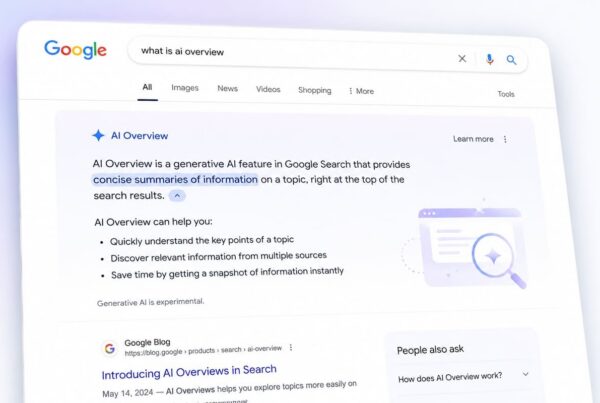
AI Overviews: summaries generated by Google at the top of search results. Origin: Google, 2024. Use: they capture the click before the blue links. Appearing in them protects your traffic. Tied to the phenomenon of zero-click searches.
AI Mode
AI Mode: Google’s conversational search mode, closer to a chatbot. Origin: Google, 2025. Use: AI Mode and AI Overviews cite different sources 87% of the time. They are two surfaces to track separately.
Query Fan-Out
Query Fan-Out: the breakdown of a user query into several sub-queries launched in parallel by the AI. Origin: Google AI Mode, 2025. Use: a single question generates several searches, multiplying the angles through which you can be cited. Details on Query Fan-Out.
Embeddings
Embeddings: a numerical representation of a text’s meaning, letting the AI compare contents by semantic proximity. Origin: information retrieval research. Use: it is through embeddings that your chunk is found. Clear text produces better embeddings.
llms.txt
llms.txt: a proposed file to guide AIs toward your priority content. Origin: community proposal, 2024. Use: three studies across 456,000 domains show zero impact on citations, but Lighthouse values it. Worth knowing to settle the debate. Our analysis: llms.txt, 3 studies say no, Lighthouse says yes.
AI crawlers (GPTBot, ClaudeBot, PerplexityBot)
AI crawlers: the robots of generative engines that crawl the web to feed answers. Origin: OpenAI, Anthropic, Perplexity, 2023-2026. Use: 25% of the top 1,000 sites block GPTBot, sometimes unknowingly. Checking your robots.txt is a prerequisite. See whether to allow these bots in 2026.
Schema.org and structured data
Schema.org: a markup vocabulary that helps engines understand your content. Origin: Schema.org, consortium founded in 2011. Use: Google deprecated FAQ rich results on May 7, 2026, but markup remains useful for entities. Details on Schema.org after the FAQ deprecation.
Earned media and off-site GEO
Earned media: citations earned on third-party sites you do not control. Origin: PR terminology adapted to GEO. Use: 64% of a brand’s AI citations come from elsewhere than its own site. Working off-site has become central. Read why 64% of your citations come from elsewhere.
E-E-A-T
E-E-A-T: Experience, Expertise, Authoritativeness, Trustworthiness, Google’s quality criteria. Origin: Google Search Quality Guidelines. Use: AIs rely on trust signals close to E-E-A-T to choose who to recommend.
How to use this glossary in your daily work as a consultant?
A glossary is useless tucked away in a tab. Here is how to turn these 35 terms into a working method with a client.
- Audit the real level. Before promising, measure whether the brand earns citations, mentions, or recommendations. The three are not equal.
- Pick the right metric. Present a presence and a portability, never a “rank.” AI rank does not exist.
- Frame expectations with volatility. Explain AI volatility from the first meeting. The client will understand why you track trends.
- Prioritize off-site. With 64% of citations coming from outside, your action plan goes beyond the client’s site.
- Track hallucinations. A low citation precision signals errors about the brand. It is a deliverable in itself.
Measure these 35 metrics automatically
Share of Voice, presence, ghost citations, hallucinations: Cockpyt tracks it all for you.
FAQ: your questions about GEO vocabulary
What is the difference between SEO and GEO in one sentence?
SEO optimizes your rank in Google’s clickable links, GEO optimizes your presence in the answers synthesized by AIs.
Does GEO replace SEO in 2026?
No, it adds to it. AIs rely on web grounding, so good SEO remains a foundation. GEO handles the upper layer: citation, mention, recommendation.
How many GEO terms do you really need to master to start?
Five are enough to start: GEO, citation, mention, presence, and AI volatility. The other 30 refine your diagnosis and your client pitch.
Why do my positions change with every query on ChatGPT?
That is AI volatility. A SparkToro study shows less than a 1-in-100 chance of getting the same list twice. You measure a frequency of appearance, not a rank.
Does an AI citation guarantee traffic?
No. 61.7% of citations are ghost citations with no brand mention, and many answers generate no click. A citation proves a read, not a visit.
Which GEO terms are false friends of SEO?
“Ranking” becomes “ghost ranking” (#1 cited but not recommended), “visibility” becomes “presence” and “portability,” and “impression” becomes “impression score” weighted by position.
Sources
- Aggarwal, P., Murahari, V., Rajpurohit, T. et al., “GEO: Generative Engine Optimization,” Princeton University, arXiv:2311.09735, 2023 (ACM KDD 2024). arxiv.org/abs/2311.09735
- Indig, K., “The Ghost Citation Problem,” Growth Memo, 2026. growth-memo.com
- Indig, K., “The Consensus Gap,” Growth Memo, 2026. growth-memo.com
- Fishkin, R. & O’Donnell, P., “AIs are highly inconsistent when recommending brands or products,” SparkToro × Gumshoe.ai, 2026. sparktoro.com
- Ahrefs, “AI Overviews vs AI Mode,” 2025. ahrefs.com
- Seer Interactive, “LLM Ghost Citations,” 2026. seerinteractive.com
- Pinecone, “Chunking Strategies,” 2024. pinecone.io
- Google Search Central, “AI Features and Your Website,” 2024-2026. developers.google.com
Article written by Florian Zorgnotti, SEO & GEO consultant. Data current for 2026.