
Key takeaways
- For the same prompt on the same day, Gemini and AI Mode agree on only 36% of the brands they cite and 10% of their source pages, according to a Sitefire analysis of 650,545 answers.
- The two products neither search as much nor favor the same sources: AI Mode draws widely from commercial sites and forums, while Gemini leans on institutional sources.
- Google offers two separate switches: Google-Extended cuts grounding in the Gemini app, the Search Console setting cuts AI Mode, and about one French website in ten already blocks the first without touching the second.
- Diagnose each gap by recording brands and domains in both engines, on the same day, over several days: where you disappear tells you which lever to work on.
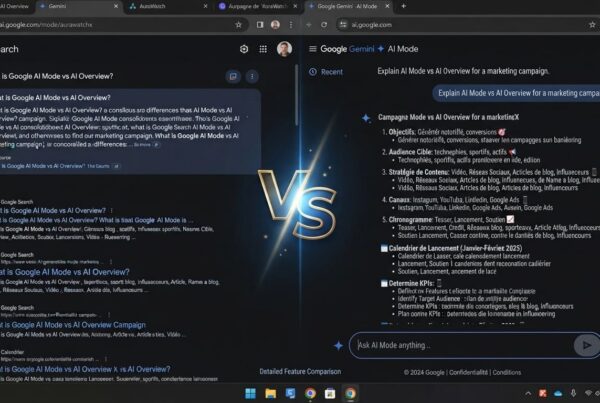
Gemini and AI Mode do not cite the same brands because they do not work the same way, despite sharing the same logo. The Gemini app often answers from what the model already knows and cites few pages. AI Mode triggers a series of searches in Google’s index and compiles far more sources.
The gap is measurable. For the same prompt on the same day, Gemini and AI Mode agree on only 36% of the brands they cite and 10% of their source pages, according to an analysis of 650,545 answers published by Sitefire in July 20261.
So you can be recommended in one and absent from the other without changing anything on your site. In France, the gap even has a technical cause few sites know about: Google provides two independent access settings, one for each product.
I’m Florian Zorgnotti, an SEO consultant for more than ten years and co-founder of Cockpyt AI, an AI visibility tracking tool. Here are the four causes of the gap, and the method to find out which one applies to you.
Is ChatGPT recommending your brand?
Measure your presence and see which brands are cited instead of yours. No credit card required.
Do Gemini and AI Mode really cite different brands?
Yes, and the gap is wider on sources than on brands. Two independent studies published in 2026 reach the same conclusion through different methods.
Sitefire paired 650,545 answers from ChatGPT, Gemini and AI Mode by prompt and by day, between June 1 and July 19, 2026. Between Gemini and AI Mode, agreement reaches 36% on brands and 10% on cited pages. In 32% of cases, the two answers share no source page at all.
In April 2026, BrightEdge compared the top 100 domains cited by five engines across nine industries. Gemini shares only 27% of its main sources with AI Mode, versus 39% with ChatGPT. The two surfaces built into Search, AI Mode and AI Overviews, are far more alike, with 59% overlap.
The paradox is surprising: Gemini, a Google product, looks more like ChatGPT than like its neighbor AI Mode. BrightEdge draws a clear conclusion: “Google AI” is not a single channel.
Brands converge more than sources
On every pair of engines, agreement on brands far exceeds agreement on pages. Sitefire measures a ratio of about four to one. The engines take different paths to land, one time in three, on the same names.
That nuance changes how you read your results. Being named in an answer does not guarantee your site serves as a source, and the reverse is also true. A brand can appear in Gemini because the model knows it, without any page being linked.
Why don’t Gemini and AI Mode work the same way?
Because one is a conversational assistant and the other a generated results page. Same model family, two products, two search logics.
Cause #1: AI Mode searches much more
AI Mode applies the query fan-out technique: it breaks your question into sub-queries, runs those searches in parallel in Google’s index, then assembles a synthesis. Sitefire counts an average of 10.5 cited pages per answer in AI Mode, versus 3.1 in Gemini.
Over seven weeks, AI Mode drew on about 118,000 different websites, Gemini on 44,000. The wider the net, the more secondary brands, comparison sites and niche vendors it catches. A small business that ranks well on a specific sub-query therefore has a better chance of entering AI Mode than Gemini.
Cause #2: Gemini often answers from memory
The Gemini app does not necessarily run a search for every question. The model first relies on what it has learned, then grounds its answer in Google Search when it needs to. Google calls this mechanism grounding: providing the model, at prompt time, with content from the search index.
The consequence: brands already established in the model’s memory gain the upper hand in Gemini. A recent brand, or one with little third-party coverage, depends entirely on search to exist, and Gemini triggers fewer searches.
Cause #3: the two engines do not read the same sources
BrightEdge describes Gemini as an institutional recommender: 26% of its citations come from authoritative sources (government bodies, universities, reference organizations), and only 0.2% from user-generated content. AI Mode behaves like a commercial aggregator, with 14% authoritative sources and 7% community content.
Sitefire sees the same gap from another angle: forums account for 11% of AI Mode citations, versus 7% for Gemini. A brand carried by discussions, reviews and comparisons gains ground in AI Mode. A brand cited by trade federations, public bodies or the specialized press gains ground in Gemini.
In my view, this is the most useful cause for a small business, because you can work on it. You do not choose an engine’s search volume, but you do choose where your brand gets mentioned.
The French factor: two switches for two engines
Google lets publishers cut access to each product separately, and the two settings have no link between them. A site can therefore feed AI Mode while staying invisible to the Gemini app, or the other way around.
Google-Extended cuts the Gemini app, not AI Mode
Google-Extended is not a crawler. It is a robots.txt token that tells Google whether content already crawled by Googlebot may be used to train Gemini and to ground answers in the Gemini app. Google’s documentation states that it changes nothing about inclusion in Search, and therefore nothing about AI Mode. The details of tokens and crawlers to allow are in our AI crawler guide.
This asymmetry already exists at scale. The September 2026 Cockpyt AI study of 9,891 .fr domains shows that 10.2% of French websites block Google-Extended while leaving Googlebot open. Their pages remain available to AI Mode and drop out of Gemini’s grounding.
The Search Console setting cuts AI Mode, not the Gemini app
Since AI Mode launched in France on July 22, 2026, Search Console has offered a “Search generative AI” control. In exclusion mode, your links and content disappear from AI Overviews, AI Mode and Discover’s generative features. According to Google, this setting applies to its Search products, and the Gemini app is excluded from it.
News publishers, very active on these issues in France, are the first concerned. When a media outlet excludes itself from AI Mode, its articles stop serving as sources for AI Mode, and the brands it covered lose a relay. The same article can keep feeding Gemini.
In my view, this is the blind spot of most GEO audits in France. We compare answers and look for content causes, when part of the gap comes from one line in a robots.txt or one button in a Search Console, sometimes yours, often your sources’.
Gemini or AI Mode: what sets them apart, point by point
The differences fit into six criteria, from search method to measurement tools. This table brings together published data and Google’s documentation.
| Criterion | Gemini app | Google AI Mode |
|---|---|---|
| Search method | Search triggered when the model needs it | Query fan-out: several sub-queries for each question |
| Pages cited per answer | 3.1 on average (Sitefire) | 10.5 on average (Sitefire) |
| Preferred sources | Institutions, reference bodies, brand websites | Commercial sites, comparison sites, forums, press |
| Community content | 0.2% of citations (BrightEdge) | 7% of citations (BrightEdge) |
| Exclusion setting | Google-Extended token in robots.txt | “Search generative AI” control in Search Console |
| Measurement provided by Google | None | Search Console generative AI report |
The last row matters as much as the others. Google shows you your impressions in AI Mode, but nothing about the Gemini app. Without external tracking, half of the diagnosis stays in the dark.
A third surface complicates the picture further: AI Overviews. BrightEdge puts them in a category of their own, with 18% of citations from community content, more than double AI Mode. Yet AI Mode and AI Overviews share 59% of their main sources, making them the two closest Google surfaces. If you already work on your presence in AI Overviews, part of the effort benefits AI Mode, almost none of it Gemini.
For a small business, the practical consequence is simple. A single “Google” strategy actually covers two related surfaces and an assistant that follows its own logic. The methods to appear in AI Mode do not transfer as-is to Gemini.
How do you diagnose the gap between Gemini and AI Mode for your brand?
By asking both engines the same prompts on the same day, and recording separately the brands named and the domains cited. Where you disappear points to the likely cause.
Step 1: check your two switches
Open your robots.txt and look for a User-agent: Google-Extended line followed by a Disallow. Then open Search Console, Settings menu, “Search generative AI” section. Ten minutes are enough, and this check sometimes explains the whole gap on its own.
Step 2: record brands and domains on the same prompt basket
Pick 10 to 20 commercial prompts, the ones a prospect asks before buying. For each one, record in both engines:
- the brands named, in order, including yours;
- the domains cited as sources, with or without a link;
- the date and access mode, in a private window or from an account with no history.
Step 3: repeat over several days
Answers vary from one day to the next, especially on the source side. Three spaced-out readings beat a single one. Sitefire notes that AI Mode’s source mix moved less than 1.5 points over seven weeks, while Gemini’s varied more.
Step 4: read your position in the matrix
Cited in both. Your entity is solid. Watch your position and the competitors cited next to you.
Cited in AI Mode, absent from Gemini. Check Google-Extended, then your presence in your industry’s authoritative sources: federations, professional directories, specialized press.
Cited in Gemini, absent from AI Mode. Check the Search Console setting, then your ranking on fan-out sub-queries and your presence in comparison sites, reviews and forums.
Absent from both. The problem is upstream: entity awareness, third-party coverage, pages that clearly answer your customers’ questions.
This matrix is a reading grid, not proof. It tells you where to look first, and your tracking over time confirms or rules out the hypothesis.
Should you optimize for Gemini or AI Mode first?
For neither in particular: work on the common foundation, then on the engine-specific layer where you are losing. As Sitefire points out, brand websites account for 46% to 57% of citations on every engine studied. Your own site remains the only lever that pays off everywhere.
The common foundation comes down to three workstreams. Pages that directly answer your customers’ questions, a consistent entity everywhere your brand appears, and a presence in reliable third-party sources.
The specific layer is then decided engine by engine. For Gemini, target your industry’s authoritative sources. For AI Mode, cover the sub-queries generated by fan-out and take care of your presence in comparisons and reviews. The same reasoning applies beyond Google: ChatGPT, Perplexity and Mistral’s Le Chat each have their own source preferences.
Measure each engine separately
A single AI visibility score, all engines combined, hides exactly what this article describes. With 36% of brands in common, an average between Gemini and AI Mode matches no real answer. Track your share of voice engine by engine, and be wary of comparing scores across tools, which never measure exactly the same thing.
For AI Mode, the Search Console generative AI report, open to all sites since August 31, 2026, gives your impressions by page. The detailed method is in our guide to measuring your presence in AI Mode. For Gemini, you need external tracking. I co-founded Cockpyt AI, which tracks your citations in ChatGPT, Gemini and Perplexity every week, without covering AI Mode: take this with the necessary distance, and combine both sources of measurement.
Is ChatGPT recommending your brand?
Measure your presence and see which brands are cited instead of yours. No credit card required.
Frequently asked questions about Gemini and AI Mode
Does AI Mode use the same model as the Gemini app?
Google presents AI Mode as a custom version of Gemini serving Search, but the product differs: it imposes query fan-out and systematically draws on Google’s index. The same base model can therefore produce very different answers depending on the product around it.
Does blocking Google-Extended remove me from AI Mode?
No. Google-Extended affects Gemini training and grounding in the Gemini app. AI Mode relies on the search index fed by Googlebot, which this token does not touch.
Does the Search Console generative AI report cover Gemini?
No. It covers AI Overviews, AI Mode and Discover’s generative features. The Gemini app is not included, and Google provides no equivalent report for it.
Is ranking first on Google enough to be cited in AI Mode?
No. AI Mode runs several sub-queries and keeps pages that answer each of them. A page that ranks well on the main query can be skipped in favor of pages that rank better on the sub-questions.
Why does Gemini name my brand without linking to my site?
Because Gemini often names brands from what the model already knows, without triggering a search. The mention exists, the source does not. That mention is still valuable: it proves your entity is established in the model.
Is AI Mode available in France?
Yes, since July 22, 2026, at the same time as AI Overviews, after more than a year of delay tied to the neighbouring rights dispute. It opens from the “AI Mode” tab in Google.
Sources
1 Sitefire, “Why AI Models Recommend the Same Brands but Cite Different Sources”, Jochen Madler, July 21, 2026: sitefire.ai/blog/ai-engines-cite-different-sources
BrightEdge, “Why AI Engines Cite Different Sources but Recommend the Same Brands”, April 24, 2026: brightedge.com
Google Search Central, “Google’s common crawlers” (Google-Extended), accessed October 7, 2026: developers.google.com
Google Search Console Help, “Search generative AI control”, accessed October 7, 2026: support.google.com/webmasters/answer/16908024
Cockpyt AI, “AI crawlers: have French websites chosen to be visible in ChatGPT?”, study of 9,891 .fr domains, September 2026: cockpyt.ai/en/study-ai-crawlers-french-websites
Journal du Geek, “Mode IA : c’est quoi ce nouvel onglet déployé discrètement par Google ?”, July 27, 2026: journaldugeek.com