Home / Features / GEO audit

The GEO audit, the deliverable that tells you what to fix

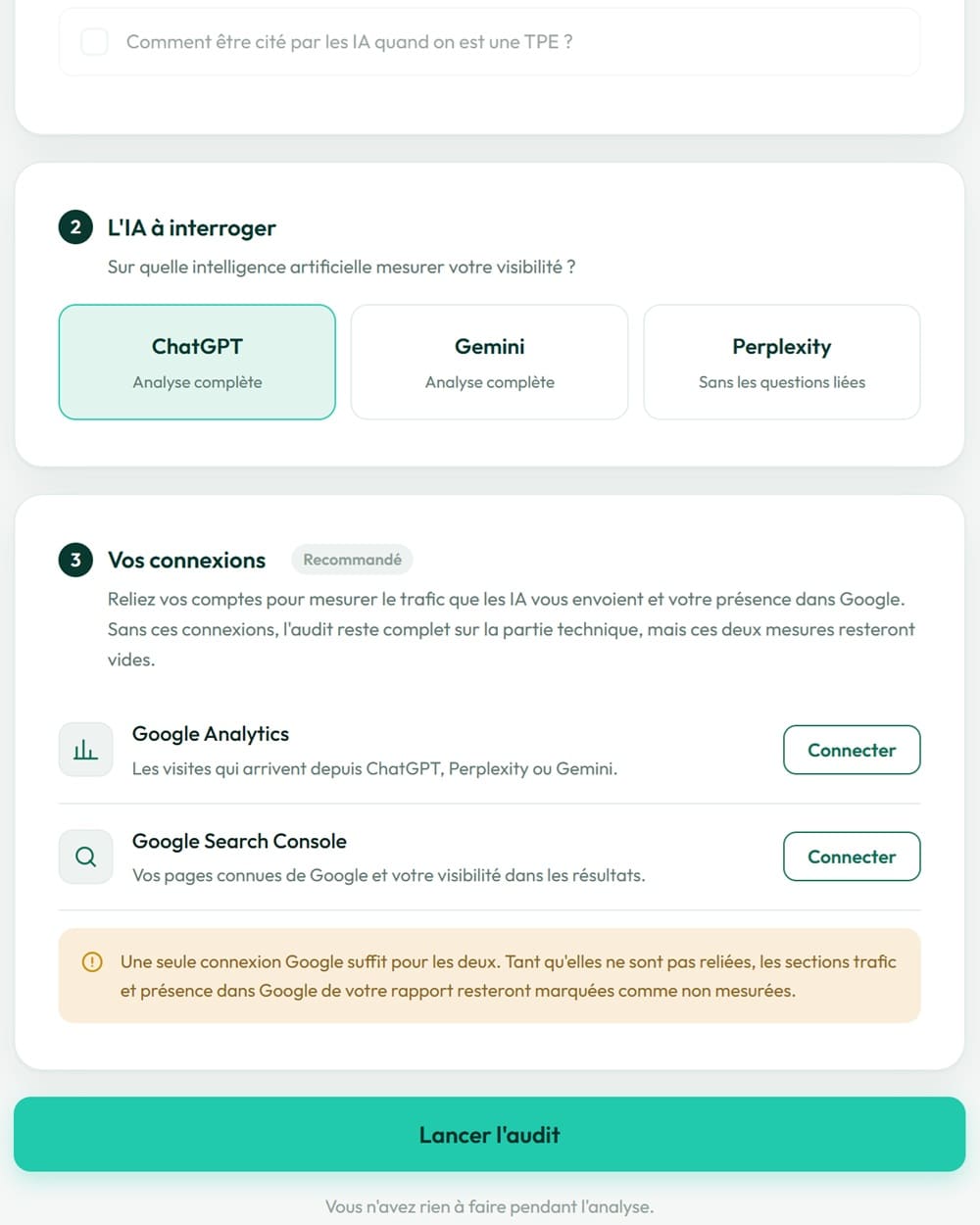
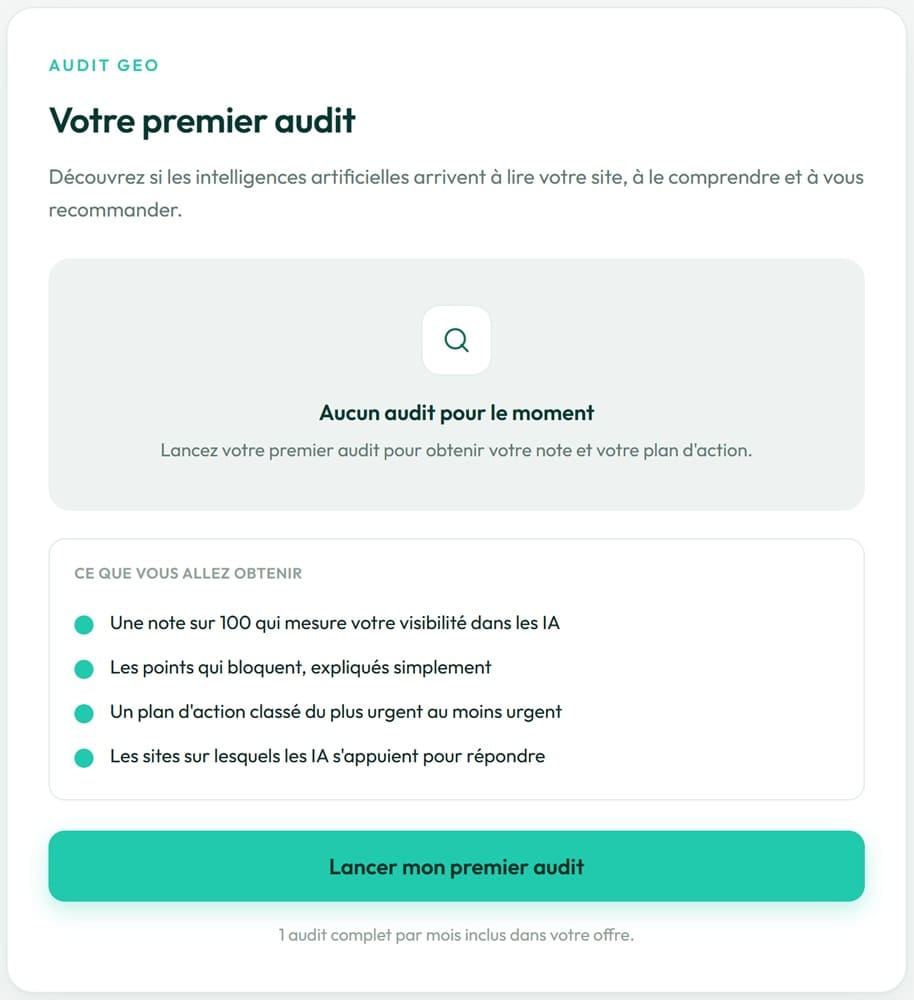
A dashboard tells you where you stand. The audit tells you what to do, in what order, and why. You run it whenever you need it, on the project of your choice, with the AI credits included in your plan.

Run an audit for free 14 days, no credit card, 100 free AI credits: enough to run a full audit

A diagnosis is never enough

Most AI visibility tools stop at the diagnosis. You learn that you are cited on three questions out of fifteen, that two competitors are ahead of you, and you close the tab without knowing where to start.

The problem is that the cause of low visibility is rarely where you look for it. A brand can produce excellent content and stay invisible because its firewall blocks AI crawlers. Another can be technically flawless and still absent because no third-party source associates it with its topic. These are two opposite diagnoses, with two action plans that have nothing in common.

The GEO audit combines three analyses to identify which of these causes applies to you, then gives you a plan ranked by impact. You know what to do on Monday morning.

The three analyses

Each one answers a different question. Together, they cover the three possible causes of low visibility.

1

Technical audit

Can AI platforms read you?

We check what AI crawlers actually see on your site: the rules that allow or block them, the security protections that often filter them without anyone having decided so, and the content loaded in JavaScript that does not exist for them.

It is the most frequent cause and the least suspected. A site that ranks perfectly on Google can be completely invisible to an AI.

2

Scan of your questions

Where are you cited, and where do you drop off?

From 10 to 50 of your questions are asked at the time of the audit, on the AI platforms you choose: ChatGPT, Gemini, AI Mode, Perplexity. You see where you are cited, at what position, with or without a link, and who is cited instead of you.

You size the audit to the stakes: 10 questions for a quick check, 50 for a full baseline before a redesign.

3

Traffic analysis

Does your visibility pay off?

Visits that actually came from AI platforms are cross-referenced with your measured visibility. A highly cited brand that gets no visits does not have the same problem as a rarely cited brand whose every citation converts.

This cross-referencing is what separates an awareness problem from a conversion problem, and it shapes the action plan.

What you get at the end

A prioritised action plan, ranked by expected impact and by effort required. Quick technical fixes rise to the top, longer projects are identified as such, and nothing is flagged as urgent by default. Each item states whether it concerns content, technical work or third-party sources, so you know who should handle it.

The plan can be exported for your team or your client, white-label from the Consultant plan upward.

Whenever you want, on the project of your choice

The audit is no longer tied to a calendar. You run it with your AI credits, at the moment that makes sense: before a redesign to get a baseline, after a round of fixes to measure their effect, or every month for a client meeting.

Its cost depends on the number of questions and the AI platforms chosen. Allow 58 credits for 10 questions on ChatGPT, Gemini and AI Mode, and 91 credits for 20 questions, action plan included. The exact cost is shown before each run.

As for frequency, keep in mind that AI platforms take 3 to 8 weeks to pick up new or edited content. Rerunning an audit every week would mean rereading the same diagnosis before your fixes have had time to take effect. Between two audits, daily tracking shows you the movement, and the Deep Scan checks whether your presence holds on a specific question.

What the audit includes during the free trial

Everything. The 100 AI credits in the trial cover a full 10-question audit on ChatGPT, Gemini and AI Mode, with the technical audit, the scan, the traffic analysis and the prioritised action plan. You then still have enough to try the Deep Scan, AI Perception and the AI agent.

If you are new to this, look at the technical part first: it tells you whether your site is readable by AI platforms, which determines everything else. Excellent content behind a technical block will never be cited.

Where the audit ends and support begins

The audit identifies, prioritises and documents. It does not change your site, write your content or negotiate your citations with third parties. That work remains yours, and most of our clients handle it in-house without difficulty using the plan provided.

If you lack time or resources, our team takes care of implementation as a service separate from the subscription. Details are on the GEO consulting page.

What feeds the audit

The audit builds on and goes deeper into what these modules measure every day.

Frequently asked questions

How much does a GEO audit cost?

It runs on your AI credits. The cost depends on the number of questions, from 10 to 50, and on the AI platforms chosen, plus 25 credits for the action plan. A 10-question audit on ChatGPT, Gemini and AI Mode uses 58 credits, a 20-question audit 91 credits. Your credits are included every month: 200 on Solo, 400 on Consultant, 700 on Agency, 1,200 on Scale. The credit simulator gives you the cost of your setup.

How long does an audit take?

You start it from your dashboard and it runs without any action on your part. The report is available in your account when the analysis is complete. There is nothing to install and nothing to configure beyond connecting Google Analytics, which the traffic part requires.

How many questions and which AI platforms should I choose?

For a first audit, 10 to 20 questions on ChatGPT, Gemini and AI Mode give a representative reading of your main angles. Go up to 50 questions for a full baseline, and add Perplexity if your audience uses it. Your other questions remain tracked every day in your dashboard.

Do I need technical skills to apply the action plan?

It depends on the item. Editorial recommendations can be applied by someone who manages content. Technical fixes, such as unblocking crawlers or configuring a security protection, require access to your hosting or help from your developer. Each item in the plan states which type it is.

How is it different from a classic SEO audit?

An SEO audit looks at what influences your rank in a list of links: internal linking, tags, speed, link building. A GEO audit looks at what influences your presence inside a written answer: accessibility to AI crawlers, citable content, third-party sources that associate you with your topic. The two overlap in part, but the priorities are not the same.

Does the audit change my site?

No, never. The audit reads and analyses, it writes nothing. No change is made to your site, your content or your configuration. You remain the sole decision-maker on what you apply and what you leave aside.

I am new to this, where should I start?

With a 10-question audit during the free trial, looking at the technical part first. Within minutes it tells you whether your site is readable by AI platforms, the first thing to fix, because no editorial work makes up for a technical block. Our article on how to run a GEO audit (in French) covers the full process.
Start by finding out whether AI platforms can read you

Create your project and run your first GEO audit with the free credits. The technical part is the question to settle before all the others.

Run an audit for free 14 days, no credit card, no commitment