
Key takeaways
- Perplexity doesn’t rank your pages, it extracts standalone blocks from them: the exact match between your headings and the query matters more than on ChatGPT.
- Cited sources diverge sharply from one engine to another. A brand visible on ChatGPT can stay absent from Perplexity.
- Perplexity prioritises four signals: freshness, the question-and-answer format, lists, and topical depth.
- The number of sources cited per answer is shrinking. Fewer slots available, and a growing edge for sites already established.
Perplexity Doesn’t Rank Your Pages, It Extracts Blocks From Them
Perplexity works as an answer engine, not a link engine. It reads the web in real time, selects passages from the pages it deems reliable, then assembles an answer with its citations. That distinction changes everything. Google ranks pages so a human will click. Perplexity lifts blocks of text so a model can reuse them.
This mechanism relies on RAG (Retrieval-Augmented Generation): the engine retrieves content, then generates its answer from those extracts. Your page no longer competes for a click. It competes to become the passage Perplexity can lift and cite as is.
ChatGPT and Perplexity don’t process your content the same way. ChatGPT synthesises: it blends several sources into a single answer. Perplexity stays more literal. When a block on your page answers the query exactly, it often lifts it without rewording. Content designed to read well from top to bottom isn’t enough. Each section has to stand on its own.
So you no longer optimise a page. You optimise a series of standalone blocks, each able to answer a precise question.
Why Doesn’t Your ChatGPT Playbook Work on Perplexity?
Your ChatGPT strategy fails on Perplexity because the two engines don’t select their sources by the same criteria. The costliest reflex is to assume content visible on ChatGPT will be visible on Perplexity too. The available data contradicts that idea.
Source selection diverges sharply. According to Omnia’s analysis (2026), YouTube is cited roughly 12 times more often on Perplexity than on ChatGPT, while Wikipedia is cited about 40 times more on ChatGPT. A brand built on editorial or encyclopedic authority performs on ChatGPT and stays quiet on Perplexity. The reverse holds for a site rich in video or blog content.
The processing mode isn’t the same. ChatGPT blends several pages into one answer. Perplexity lifts a precise block when it matches the query. The exact match between your headings and the phrasing of the questions therefore weighs far more on Perplexity.
Freshness plays a bigger role. Analyze AI’s analysis (2026) shows a stronger recency bias on Perplexity than on ChatGPT, especially in fast-moving sectors. Content left untouched loses its slot to a competitor who updates theirs.
Citations stay visible, and that’s an opportunity. Perplexity shows links on nearly every answer. ChatGPT, in closed mode, often shows none. Perplexity remains the most workable generative engine for a brand that wants to track its citations.
| Axis | ChatGPT | Perplexity | What you change |
|---|---|---|---|
| Source selection | Favours encyclopedic and editorial authority | Cites video and specialised blogs more | Don’t assume ChatGPT visibility transfers |
| Content processing | Synthesises several pages | Lifts a literal block from one page | Align titles and H2s with the exact phrasing of queries |
| Freshness | Moderate weighting | Marked recency bias | Update your high-potential pages continuously |
| Displayed citations | Often none in closed mode | Links cited on nearly every answer | Treat Perplexity as the most traceable engine |
| Technical rendering | JavaScript rendering close to Google | Limited JavaScript rendering | Check that your content displays without JavaScript |
The source pool is tightening, and that amplifies every one of these divergences. According to Omnia (2026), the number of domains cited per answer on Perplexity fell from 11.8 in November 2025 to 7.5 in April 2026. Fewer slots available, and a growing edge for sources already established within a cluster.
The 4 Signals Perplexity Values More Than Other AI Engines
Four signals weigh more on Perplexity than on other generative engines. Working on them first produces more effect than a classic SEO audit.
Freshness: A More Marked Recency Bias
Perplexity presents itself as a real-time search engine. It refreshes the sources it cites most often, and prefers recently updated content. Display a visible update date, and reflect it in your structured data. Then set a refresh rhythm based on the pace of your sector: quarterly for a stable topic, monthly for one that moves fast.
The Question-and-Answer Format and Lists
Perplexity lifts a clear block more easily than a dense paragraph. Analyze AI’s analysis (2026) shows that question-and-answer formats reach the Top 3 in 55% of cases, against 31% on average. Structured lists follow close behind. Open each section with a direct one-to-two-sentence answer, then expand. Add a genuine FAQ section, with questions that mirror your audience’s phrasing.
Exact Match With the Query
Perplexity stays more literal than ChatGPT. It favours pages whose titles and subheadings reuse the exact phrasing of the query. Identify the precise questions your audience asks, then align your title tags, your H1s and your H2s with those phrasings. A close semantic variation isn’t always enough to win the citation.
Topical Depth and the Flywheel Effect
Once cited on a topic, your domain sees its odds of being re-cited rise on neighbouring queries. Perplexity tends to reuse the sources it already knows within a cluster. Topical concentration predicts position better than raw domain authority. Cover three to five clusters in depth, rather than twenty topics on the surface.
How to Get Cited by Perplexity: The 5-Step Method
To get cited by Perplexity, follow a five-step sequence, from audit to tracking.
- Audit your current presence. Type your target queries into Perplexity. Note whether your domain appears, at what position, and who is cited in your place.
- Rewrite your introductions as direct answers. The first sentence has to answer the question, as a statement. No warm-up.
- Restructure your content into standalone blocks. Each section answers a single question, with a heading that reuses the phrasing of the query. This is the principle of chunking.
- Check rendering without JavaScript and PerplexityBot access. Client-side rendered content can be read empty by Perplexity. Also check that your robots.txt doesn’t block PerplexityBot.
- Build depth and track your positions over time. Cover your cluster from every angle, then measure the change week after week.
Steps 2 and 3 handle form. For the detailed method, see our guide to rewriting your intros. Steps 4 and 5 handle technique and duration: the JavaScript test deserves a checkpoint of its own. You can start step 1 today, with no tool at all.
Do You Need a Different Strategy for Perplexity, ChatGPT and Gemini?
Yes, each engine calls for adjustments, but a common base exists. The divergence in sources and extraction modes prevents a single strategy from perfectly optimising all three engines at once. Part of the work travels very well from one engine to another, though.
- What travels well: the direct answer at the top of a section, the standalone-block structure, structured data, freshness.
- What needs a per-engine adjustment: the choice of sources to work on, the exact query-to-title match, the weight given to video.
The logic comes in two steps. First you build the common base. Then you adjust per engine, from what you observe. And you can only adjust per engine if you measure per engine.
How Do You Measure Your Visibility Gains on Perplexity?
You measure your visibility on Perplexity on three fronts: referral traffic, real citation, and position over time.
Referral traffic appears in GA4 under the perplexity.ai domain. That data stays partial. A citation without a click is still a citation, and a gain in awareness for your brand.
Real citation is verified by testing your target queries by hand: who is cited, at what position, on which source. The exercise quickly becomes heavy across a full cluster, and heavier still once you add your competitors.
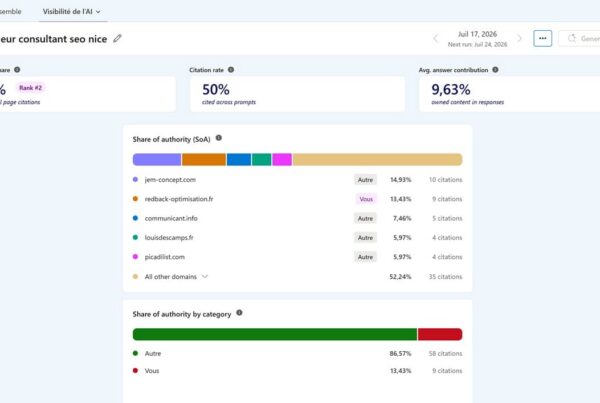
Position over time is the real indicator. What matters isn’t a snapshot, it’s the trend. I built Cockpyt AI to automate that tracking: your citations, your position and your competitors, on Perplexity as on the other AI engines, with no manual testing.
FAQ
Does Perplexity use the same index as Google?
No. Perplexity relies on its own index, supplemented by the Bing index for long-tail queries. Its own index is refreshed faster than Google’s for the sources it cites most often.
How long does it take to get cited by Perplexity?
Faster than on a classic engine, because Perplexity runs in real time. A page already indexed and already cited reacts within days to an update. A brand-new URL takes longer, since the engine first has to discover and crawl it.
Does schema markup help you get cited by Perplexity?
Yes. The FAQPage, HowTo and Article schemas help Perplexity parse and prioritise your content. Analyze AI’s analysis (2026) shows that pages with structured data reach the Top 3 more often than pages without markup.
Do you need a blog to be visible on Perplexity?
The blog remains the format that generates the most citations by volume. But comparison and review pages earn a better average position. The format of the page matters as much as having a blog at all.
Can PerplexityBot access my site?
Check that your robots.txt file doesn’t block the PerplexityBot agent. If the engine can’t crawl your site, it can’t cite you. It’s a simple technical checkpoint, and an often-overlooked one.
Does domain authority still matter for Perplexity?
It matters, but less exclusively than on Google. Topical depth predicts position more reliably than raw authority. A specialised, focused site can outrank a generalist publisher with a stronger backlink profile.
Sources
- Omnia, “How to Improve Visibility & Rank in Perplexity AI”, useomnia.com, April 27, 2026.
- Analyze AI, “How To Rank On Perplexity AI (Based On Analysis Of 65,000 Prompt Citations)”, tryanalyze.ai, January 12, 2026.